
Cocktail Napkins Custom
You've poured the wine, set out the olives, and arranged the glasses so carefully that the table looks effortless. Then you notice the napkins. A plain stack from the supermarket suddenly feels like the one detail keeping the evening from looking finished.
Custom cocktail napkins solve that problem. A monogram, a small botanical motif, or a line that makes guests smile can turn an ordinary drink service into a considered part of the occasion. The right napkin isn't only absorbent. It identifies the host, establishes the mood, and gives guests a small detail to remember.
Why Custom Cocktail Napkins Earn Their Spot on the Table
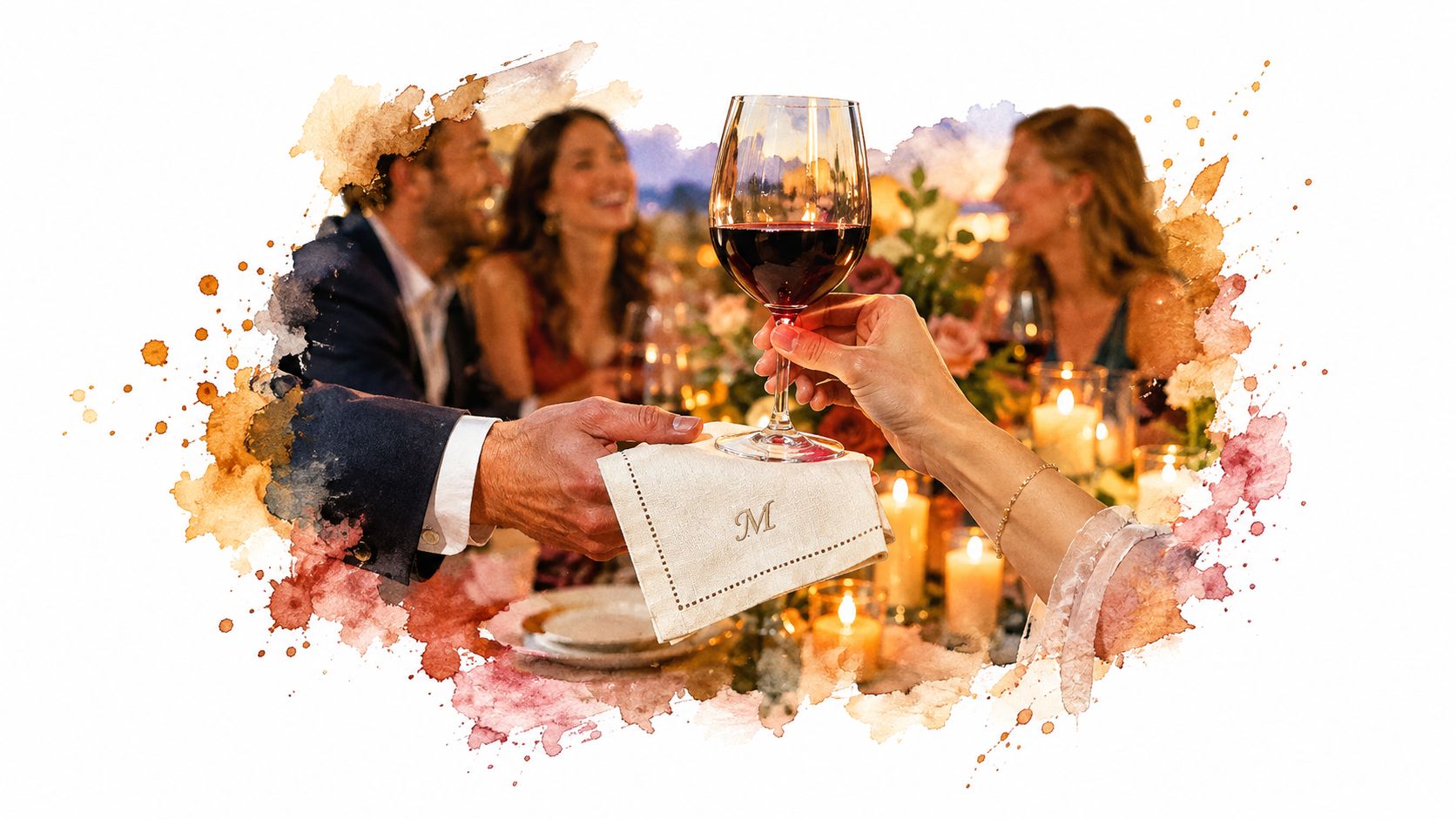
At a recent dinner, I placed a stack of ivory cocktail napkins beside the wine tray. Each carried a small serif initial in a muted thread color. Nobody commented immediately, which is usually a good sign. The napkins looked as though they belonged there, alongside the glassware and candles, rather than announcing themselves as a last-minute party purchase.
Later, one guest picked up a fresh napkin and asked where I'd found it. Another tucked one beside her glass before moving to the terrace. That's the appeal of personalized entertaining pieces. They do their practical job while giving the table a sense of authorship.
Napkins have served both purposes for centuries. Evidence places early paper napkin use in ancient China, while one of the earliest English references to table napkins dates to 1384–1385. Paper napkins reached the United States in the late 1800s, but broader social acceptance arrived in 1948, when etiquette authority Emily Post favored paper napkins over linen for some forms of entertaining. The history of napkins shows how a functional object gradually became part of social presentation.
More than spill protection
The modern cocktail napkin also inherited the personality of cocktail culture. During Prohibition, from 1920 to 1933, small napkins were reportedly used in bars for drink recipes, sketches, and notes. By the 1950s and 1960s, colorful designs and humorous sayings made napkins collectible, and by the 1980s and 1990s, bars and beverage companies used branded napkins as marketing tools. This brief history of cocktail napkins traces that progression from practical service to decoration and communication.
That history explains why a custom napkin feels surprisingly expressive. A plain bar napkin says, “Here's something to catch a drip.” A personalized napkin says, “This gathering has a point of view.”
Before ordering, decide what your napkin needs to accomplish:
- Support the service: Will it sit beneath wine, cocktails, passed appetizers, or dessert?
- Identify the occasion: Is it for a wedding, a birthday, a holiday, or regular Friday drinks?
- Reflect the host: Should it feel polished, playful, sentimental, or traditional?
- Earn repeat use: Do you want a keepsake, a reusable set, or an attractive single-event detail?
For more ideas on using small details to shape a party, explore how cocktail napkins can make a party stand out. The best order is never decoration first. It's a practical decision about how you host and what you want guests to feel.
Choosing Materials and Sizes That Work for Real Hosts
A napkin should match the way you host. Reusable cloth suits recurring dinners and gift-worthy entertaining, while printed paper handles volume, spills, and quick cleanup. Choose the material first, then select a size and finish that will survive the event you have planned.
Reusable cloth gives a table a polished textile finish and earns its keep across repeated gatherings. Cotton feels approachable and absorbs well. Linen adds relaxed texture and photographs beautifully, though it wrinkles more readily. Hemstitch cloth has the most formal appearance, with a defined border that makes a bar cart or place setting look considered without excess decoration.
Printed paper makes sense for large gatherings, outdoor parties, messy menus, and occasions when laundry is inconvenient. It is easy to distribute and clear away, and it gives a short message, logo, illustration, or date room to do the visual work. The familiar cocktail format is approximately 5 by 5 inches, a compact square that fits beneath a glass or in one hand with a small bite.
Match the napkin to the event
A weekly cocktail hour needs a different system from a crowded open house. Use this table as a practical starting point:
| Material | Look and Feel | Care | Best For |
|---|---|---|---|
| Cotton | Soft, absorbent, relaxed | Machine wash according to maker's directions | Casual dinners, family gatherings, repeat use |
| Linen | Textured, airy, naturally elegant | Gentle laundering and careful pressing | Wine evenings, summer tables, refined hosting |
| Hemstitch cloth | Structured, crisp, heirloom-like | Launder gently, dry thoroughly, press or fold neatly | Hostess gifts, weddings, formal cocktail hours |
| Printed paper | Lightweight, graphic, convenient | Disposable after use | Large parties, outdoor events, high-spill menus |
The paper-versus-cloth choice also depends on your care routine. According to The home entertaining report, cloth napkins used 50–100 times can produce up to 73% less waste than an equivalent quantity of paper napkins. Laundering still requires water, detergent, drying energy, and time, so reusable cloth suits hosts who will wash, dry, and store it.
Practical rule: Choose cloth when you will use the set repeatedly and have a realistic care routine. Choose paper when speed, volume, or cleanup matters most.
For a small dinner, hemstitch cloth usually wins. For a self-service buffet, disposable napkins may be the more sensible system. The cited report found that self-service buffet was the most popular format at 50%, while 47% of surveyed consumers held a food-and-drink gathering during the prior year and 7% usually used catering. Those figures point to a useful hosting principle: choose a napkin system that fits the work your event creates, not one that merely looks impressive in the package.
Picking a Monogram, Motif, or Message That Fits the Occasion
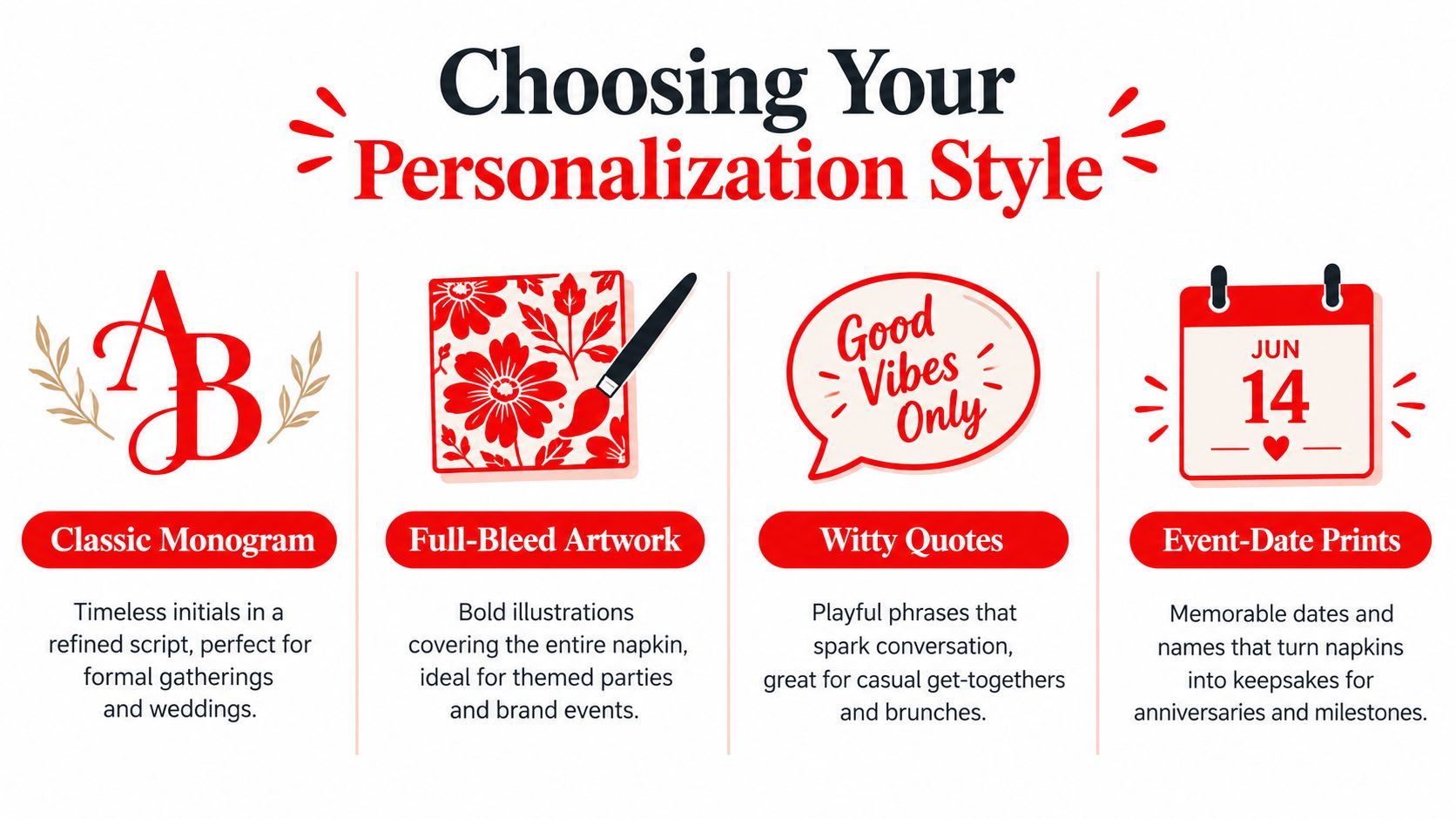
Personalization should answer one question: what should this napkin communicate before the guest takes a sip? A single initial feels composed. A cheeky phrase feels social. An event date turns the napkin into a keepsake.
The classic monogram
A monogram is my first choice for a wedding, anniversary, housewarming, or hostess gift. Keep it compact and legible. One or two initials in a serif or restrained script will look more expensive than a crowded arrangement that tries to include every name and date.
A monogram also works beautifully for a home bar because it doesn't lock the napkin to one party. Choose a neutral base and a thread color that coordinates with your glassware, tray, or table linens.
Full-bleed artwork
Use full artwork when the design itself is the entertainment. A coastal shell, citrus branch, holiday illustration, or destination motif can give a bar tray an immediate theme. This approach suits casual gatherings, brand events, showers, and parties where guests are expected to notice the visual joke.
The design needs breathing room. A dense illustration can disappear when folded, especially on a small cocktail napkin, so ask where the artwork will sit and whether the important details remain visible in the guest's hand.
Witty quotes
A witty message belongs at a relaxed cocktail party, brunch, birthday, or girls' weekend. Keep it short enough to read without turning the napkin into a paragraph. The best lines create a smile while guests wait for a drink, such as a playful toast, a family expression, or a phrase connected to the menu.
Avoid humor that needs explanation. If guests have to ask what the message means, the napkin has become a conversation obligation instead of a conversation starter.
Event dates and names
Dates are ideal for weddings, milestone birthdays, anniversaries, and reunions. They give an otherwise temporary item a reason to remain in a memory box. Pair the date with a small motif or initial rather than adding several lines of text.
For formal tables, let the napkin coordinate with the setting. Oregon State University Extension recommends napkins that are clean, wrinkle-free, and positioned so they don't disturb the flatware. A folded napkin generally sits to the left of the fork with the open corner facing the lower right, or on the plate when a napkin ring or decorative fold is used. These table-setting guidelines make the napkin part of the table's architecture, not an afterthought.
For more inspiration, see these monogrammed linen napkins for refined entertaining. My strongest recommendation is to choose one visual language and repeat it. Match the font, palette, or illustration style across the bar, buffet, and table rather than making every station compete.
Designing Your Napkin Step by Step
A good custom order feels collaborative. You bring the occasion and the point of view. The maker should help you translate that idea into a design that still reads clearly at cocktail size.
Start with one strong idea
Choose the napkin's main job before opening a design tool. For a wedding bar, that might be a shared initial. For a holiday dinner, it could be a tiny evergreen motif. For a hostess gift, a monogram or family name gives the recipient more opportunities to use it.
Don't combine a large illustration, a long message, multiple initials, and an event date just because the canvas is available. Small napkins reward editing.
Build the visual system
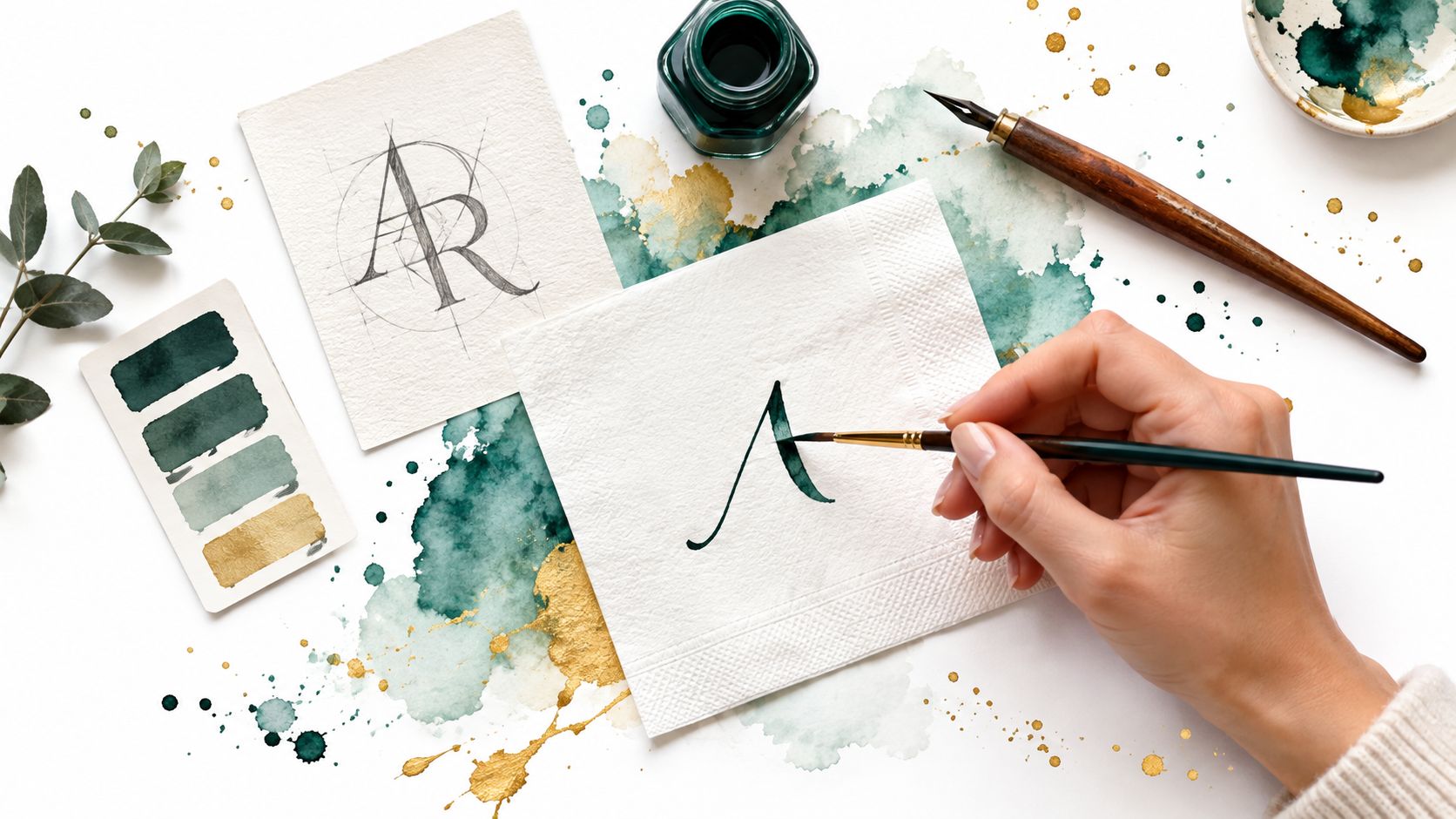
Select the base color first, then the font or artwork, and finally the thread or ink color. Contrast matters more than novelty. Ivory with deep green, white with navy, and natural linen with a warm neutral tend to read cleanly, while pale thread on pale fabric can vanish under dining-room lighting.
Ask for the design at its actual finished size. A monogram that looks elegant on a computer screen may become muddy when reduced. Check letter spacing, line thickness, alignment, and the amount of empty space around the mark.
Push back on a proof if: the initials touch, the smallest text is hard to read, the artwork is cropped awkwardly, or the personalization sits where a fold will hide it.
Approve the production details
Request a digital proof before approving the full run. If the napkins are embroidered, confirm thread color, stitch density, and how the design will sit on the hemstitch border. If they're printed, ask about ink durability, color fastness, and whether the finish may transfer when damp.
A sample or fabric swatch is especially useful for a wedding, corporate gathering, or substantial gift order. It reveals texture, scale, and color in real light. I'd rather spend time correcting a proof than spend an evening rearranging napkins to hide a design that landed too close to the edge.
This short visual guide can help when you're comparing lettering, artwork, and layout choices:
Give the final approval only after checking the spelling, initials, date, quantity, base material, and delivery address. Personalization leaves little room for casual assumptions, so the final proof deserves the same attention as a printed invitation.
Quantities, Lead Times, and Your Ordering Checklist
Ordering custom cocktail napkins is mostly a quantity exercise followed by a timing exercise. Start with how guests will use them, not with the number of people on the invitation list.
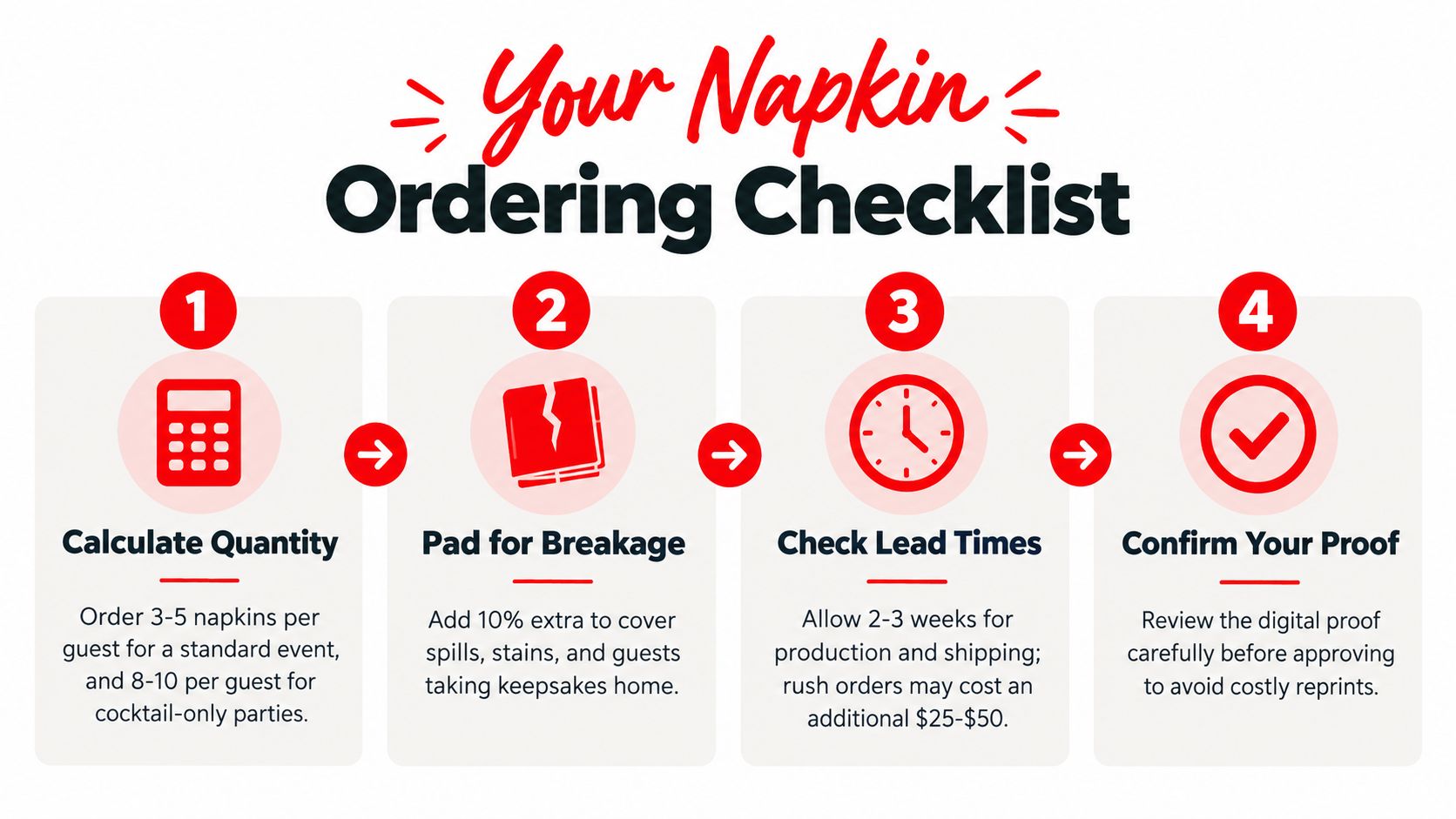
For a standard event, plan on 3–5 napkins per guest, and for a cocktail-only party, plan on 8–10 per guest, as specified in the ordering guide below. Add 10% extra for spills, stains, service needs, and guests who take a napkin home as a keepsake. This bulk buying guide for promotional products is also useful when you're comparing quantity breaks and planning a branded or large-volume order.
Calculate for service, not attendance
Think through every place napkins will appear:
- Bar service: Guests may take a fresh napkin with each drink.
- Food stations: Appetizers, dessert, oysters, and garnishes increase use.
- Welcome areas: Champagne, coffee, and favors need their own visible stack.
- Keepsakes: A few guests may carry home a personalized piece.
- Backups: Your caterer or host should have extras available before the main display looks depleted.
Jolitee's custom hemstitch cocktail napkins can be personalized with monograms, logos, or unique designs, with image upload and color selection available at a minimum order of 12 pieces. Handmade cocktail hemstitch napkins are also offered in sets of six with hand-applied designs. Those formats make small dinner-party orders possible, while larger celebrations require more deliberate quantity planning.
Confirm the calendar
Personalized goods need production time before shipping begins. Allow 2–3 weeks for production and shipping, and note that rush orders may add $25–$50, according to the ordering guide represented in the checklist. These figures belong to the supplied ordering guidance, so confirm current timing and fees with the seller before checkout.
Use this checklist before you pay:
- Quantity: Count guests, service points, and planned uses.
- Extra pieces: Add the recommended 10% buffer.
- Production: Confirm the maker's current schedule.
- Shipping: Check the delivery window against your event date.
- Sample: Request a swatch or sample for important orders.
- Proof: Verify spelling, placement, colors, dimensions, and artwork.
- Packaging: Decide whether the napkins need gift-ready presentation.
For a wedding-specific planning perspective, use this guide to deciding how many cocktail napkins you need. Place the order only after the proof and delivery plan are clear.
Care, Storage, and Getting More Use From Every Napkin
Reusable custom napkins reward a little discipline. The aim isn't to preserve them behind glass. It's to make them easy enough to use that they return to the table instead of disappearing into a linen cupboard.
Treat stains quickly. Blot red wine rather than rubbing it deeper into the fibers. Lift lipstick with a gentle pre-treatment suited to the fabric, and remove cocktail garnish residue before it dries. Don't use aggressive bleach on embroidery or colored thread unless the maker specifically approves it.
Laundering hemstitch napkins
Follow the maker's care instructions first, especially for hand-applied designs. In general, wash cloth napkins with similar colors on a gentle cycle, avoid overloading the machine, and dry them thoroughly before folding. Excessive heat can stress fabric and embroidery, while leaving damp napkins folded invites odor and mildew.
Press linen while slightly damp if you want a crisp finish. Cotton may need less attention. Hemstitch napkins look polished when folded consistently, but a relaxed fold is perfectly suitable for a casual cocktail tray.
Store the set as a working collection
Keep napkins together in a breathable drawer, basket, or lidded box. Separate event-specific sets with a paper band or fabric tie, and label the occasion if the design includes a date or monogram that isn't immediately obvious.
Printed paper napkins need dry, flat storage away from direct sunlight. Don't place heavy objects on top of delicate foil or raised printing. Keep unopened packs in their original packaging until needed, then store leftovers flat so the corners don't curl.
| Option | Laundering Effort | Repeat-Use Value |
|---|---|---|
| Cotton | Moderate | Strong for frequent casual hosting |
| Linen | Moderate to high | Excellent for recurring dinners and wine service |
| Hemstitch cloth | Moderate, with careful handling | High for gifting and formal entertaining |
| Printed paper | None | Best for single occasions and high-volume service |
The cost-per-use question is personal. A reusable set becomes more compelling when you host often, have laundry access, and enjoy maintaining a small collection of table linens. Disposable napkins make more sense when the event is unusually large, the menu is messy, or cleanup needs to end when the guests leave.
My favorite hybrid approach is simple: keep one elegant hemstitch set for dinners and intimate cocktail hours, then order custom paper napkins for outdoor parties, large celebrations, and themes that you won't repeat.
Shop the Look and Frequently Asked Questions
Custom napkins look most considered when they're part of a small entertaining story. Pair a monogrammed cloth napkin with a bottle dressed in a canvas wine gift bag, or choose a witty bottle design for a host who prefers humor to formality. For a fuller present, browse hostess gifts and entertaining accessories that can sit beside the bar cart or arrive ready to give.
How many custom cocktail napkins should I order?
Use the event formula from the ordering checklist. Standard events call for 3–5 per guest, while cocktail-only parties call for 8–10 per guest, with 10% extra added for spills, service, and keepsakes.
Should I choose cloth or paper?
Choose reusable cloth for recurring dinners, intimate cocktail hours, and gifts. Choose printed paper for large, messy, outdoor, or cleanup-sensitive events. A hybrid collection is the most practical choice for hosts who entertain in different ways.
How far in advance should I order?
Allow 2–3 weeks for production and shipping, then add personal buffer time if the event date is important. Confirm the current production schedule, rush policy, proofing process, and delivery window before submitting payment.
What personalization looks most elegant?
A restrained monogram, one small motif, or a short date line usually looks more polished than crowded text. Keep the palette coordinated with the glassware, linens, and flowers, and make sure the design remains legible at cocktail size.
Are custom napkins suitable as a hostess gift?
Yes, especially when the design reflects the recipient's taste and can be used again. Etiquette guidance recommends choosing a host gift for the recipient and occasion rather than for the giver's preferences, as explained in this host and hostess gift guide from CNN Underscored. A reusable bottle bag also presents wine attractively without implying that the host must open it that evening.
A commonly recommended host-gift range is $10 to $40, according to WCPO's host-gift advice, which also favors practical gifts that don't create extra work. Katie Couric's etiquette coverage similarly emphasizes matching the gift to the recipient's personality and respecting any request from the host.
Jolitee offers custom hemstitch cocktail napkins, canvas bottle bags, and entertaining gifts that make a thoughtful bar or tablescape feel complete. Visit Jolitee to browse the collection and choose the personalized detail for your next dinner, cocktail hour, or hostess gift.