

Travel Document Organizer Guide for Stylish Travelers
You're at the airport, already thinking about the trip ahead, when the gate agent asks for your passport and boarding pass. Suddenly, the carry-on becomes a small disaster zone. A visa printout is folded behind a phone charger, the boarding pass is buried under a paperback, and loyalty cards slide across the floor while the queue inches forward.
A good travel document organizer prevents that scramble. It brings your passport, identification, visas, itineraries, hotel confirmations, insurance details, and payment cards into one accessible folio, then works just as well at home during trip preparation as it does at the gate or hotel desk. The right design isn't about collecting the most pockets. It's about retrieving the right document quickly, protecting it from damage, and carrying it in a form that suits your trip.
The Moment You Wish You Had One
The traveler crouched beside the airport gate has tried to stay organized. The passport went into the front compartment of the carry-on. The boarding pass was saved on the phone, but the phone battery is low. A loose visa printout slipped behind a charging cable, while a vaccination card is wedged beneath a paperback that seemed like a good idea at check-in.
Then the agent calls the next passenger.
That moment exposes the difference between owning travel documents and having a travel system. A wallet holds the cards you use every day. A suitcase holds clothes. Neither gives you a reliable place for the papers that prove where you're going, who you are, and what you've already booked.
A dedicated organizer changes the sequence. You unzip or open one folio, pull out the passport, present the boarding pass, and return both to the same protected space. Hotel confirmations, printed itineraries, emergency contacts, and payment cards stay grouped instead of migrating through every pocket in your bag.
The small habit that removes a large annoyance
The best setup starts before you leave home. Put every trip-specific document into the organizer, check that each item belongs to the correct traveler, and keep the folio in your personal item rather than checked luggage. A useful guide to keep travel documents in one place makes the same practical point: documents are easier to manage when they have a consistent home.
That home should be easy to reach without unpacking your entire bag. It should also be distinctive enough that you won't mistake it for a cosmetics pouch or tech case at a crowded security tray.
The Jolitee passport holder travel wallet takes the compact approach, with an inner passport pocket, card slots, and an elastic closure. It suits travelers who want a polished, slim case rather than a large family folio.
Practical rule: If you need both hands to search for your passport, your document storage isn't doing its job.
What a Travel Document Organizer Actually Does
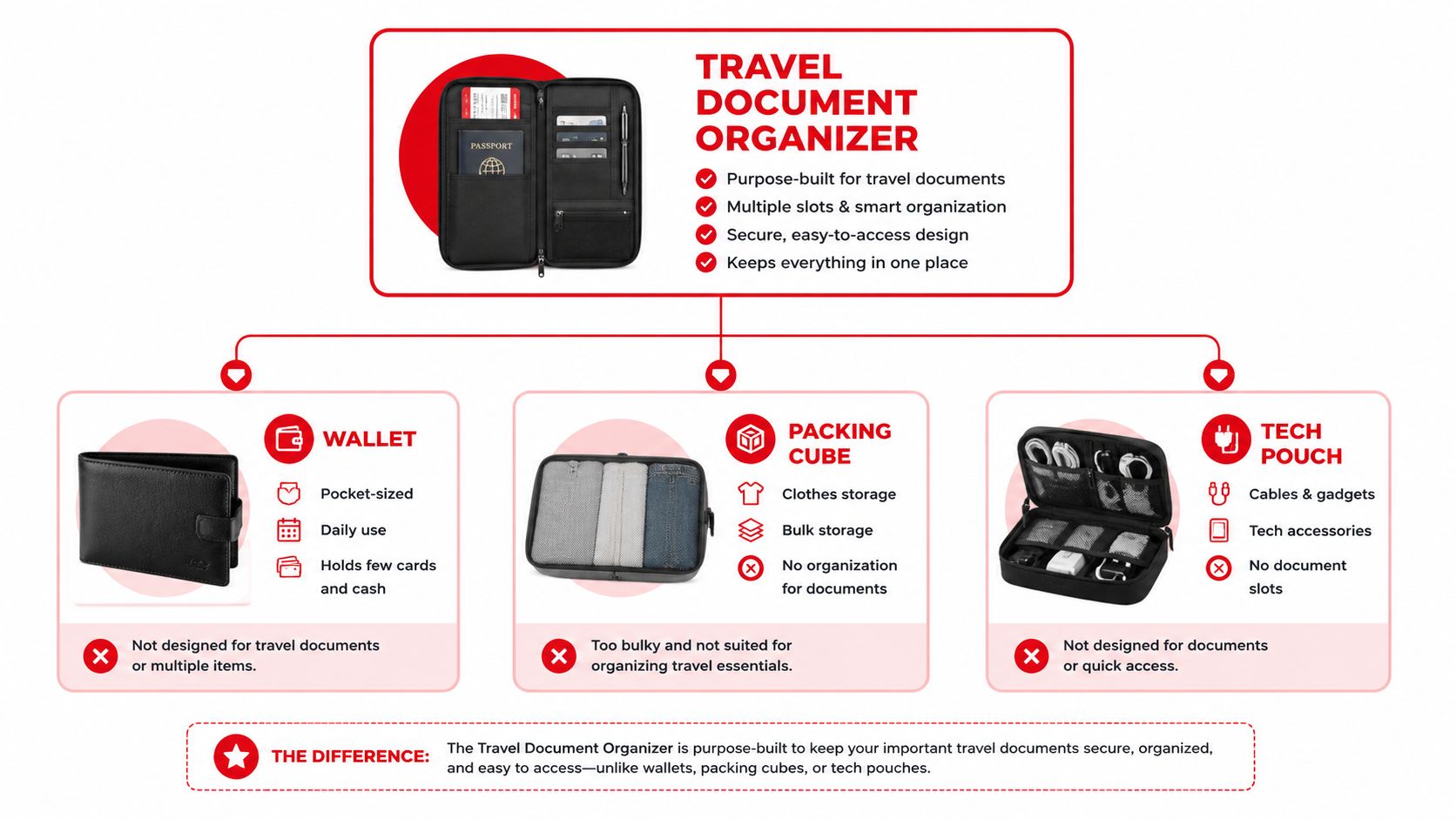
A travel document organizer is the front-desk kit for checkpoints and customs. It isn't a larger wallet, a packing cube, or a tech pouch. Each of those products solves a different problem.
A wallet is a pocket-sized daily tool for a few cards and cash. A packing cube controls clothing inside luggage. A tech pouch keeps cables, batteries, adapters, and small gadgets from tangling. The organizer handles the documents you'll repeatedly show, confirm, or retrieve throughout a journey.
What belongs inside
The contents change with the itinerary, but a well-planned organizer may include:
- Identity documents: Passport, national ID, and driver license.
- Entry paperwork: Visas, electronic travel authorization printouts, and transit documentation.
- Transport records: Boarding passes, rail tickets, transfer details, and car rental confirmations.
- Accommodation details: Hotel addresses, confirmation numbers, check-in notes, and access instructions.
- Health and insurance records: Insurance cards, policy information, and vaccination records when the destination requires them.
- Financial and emergency references: Relevant payment cards, bank contact details, and emergency contacts.
The organizer's job isn't to replace your phone. It gives paper documents a stable physical home while making the transition between home, airport, border, and hotel less chaotic.
A readiness station, not a storage drawer
At home, the organizer becomes a pre-departure staging point. During transit, it becomes an access tool. At the hotel, it gives you a place to return documents after check-in instead of leaving them loose on a counter.
The same principle applies to specialized paperwork. Travelers with pets can use a coordinated system to keep pet papers safe while traveling, especially when health certificates and vaccination records need to remain accessible. The case should hold what you need for the current journey, not every document you've accumulated over the years.
A slim case is enough for a short personal trip. Families and multi-city travelers need more separation, because mixing several passports, confirmations, and health records creates a new version of the original problem.
The Four Features That Actually Matter
Most buying decisions come down to four things: capacity, material, RFID protection, and closure. Treat them as trade-offs, not a checklist where every feature deserves equal priority.
Capacity comes first. A slim passport sleeve works beautifully when you carry one passport, a few cards, and perhaps a boarding pass. A family folio needs labeled sections, flexible document sleeves, and a zippered compartment for loose papers. Pen loops are useful for customs forms, while a removable card wallet can keep daily spending cards separate from passports.
Material determines how the case feels after repeated handling. Vegan leather offers a polished look with straightforward care. Full-grain leather develops character but adds weight and usually needs more attention. Nylon keeps the load light and tolerates rougher transit. Coated canvas brings a softer, more casual look while helping resist everyday moisture.
RFID blocking has a real but narrow purpose. Organizers with shielding layers are designed to attenuate radio-frequency coupling at common payment and passport bands, particularly 13.56 MHz, which many contactless cards and electronic passports use. RFID shielding doesn't interfere with millimeter-wave or X-ray airport screening because those systems use different sensing methods, as explained in this technical review of RFID passport holders.
Four Core Features Compared
| Feature | Common Options | Best For | Trade-Off |
|---|---|---|---|
| Capacity | Slim sleeve, bi-fold, multi-pocket folio | Solo travelers, families, multi-city trips | More storage can add bulk |
| Material | Vegan leather, leather, nylon, coated canvas | Polished gifting, durability, light packing | Appearance, weight, and care needs vary |
| RFID protection | Shielded card and passport sections | Travelers who want added contactless-card protection | It shouldn't outweigh fit and access |
| Closure | Zipper, snap, magnetic clasp, elastic band | Security, quick gate access, different packing styles | Stronger closures may open more slowly |
Closure affects the moment you need the case most. Zippers offer strong containment, snaps are quick, magnetic clasps feel elegant, and elastic bands keep a compact case shut without hardware. For a closer look at available silhouettes, browse Jolitee's passport holder collection.
My ranking is simple: choose capacity for your document volume, material for how you'll carry and gift it, closure for access speed, then RFID as a useful extra. A water-resistant exterior, reinforced seams, and a smooth closure matter more than a long feature list.
Matching the Organizer to the Traveler
There isn't one universal best organizer. The case that feels perfect for a solo weekend becomes frustrating when it has to hold several passports, while a family folio feels excessive for someone traveling with one digital boarding pass and a passport.
Four traveler types and the right fit
| Traveler Type | Ideal Organizer Features | Key Trade-Off |
|---|---|---|
| Family traveler | Tri-fold layout, labeled sections, elastic loops, space for health and insurance papers | More capacity means a larger case |
| Business traveler | Lay-flat design, corporate card slots, pen loop, laptop-sleeve compatibility | Streamlined layouts may sacrifice casual storage |
| Leisure traveler | Medium capacity, zippered coin pocket, passport sleeve, itinerary space | It won't hold a full household's paperwork |
| Jetsetter | Multiple passport sleeves, detachable card wallet, premium leather, formal styling | Premium materials can add weight and require care |
The family organizer should make each child's documents visually distinct. For a group flying with shared boarding passes, immunization cards, and insurance printouts, a tri-fold with elastic loops is more practical than a slim bi-fold. The trade-off is obvious: it occupies more room, but searching for one child's paperwork becomes far less stressful.
A business traveler needs quick access and a tidy profile. A lay-flat case that slips inside a laptop sleeve, includes corporate card slots, and holds a pen keeps customs forms and receipts from taking over the work bag. The compromise is reduced room for souvenirs and miscellaneous papers.
The leisure traveler benefits from a medium-capacity organizer. Give it space for a paperback itinerary, a few cards, and a zippered coin pocket for tipping currency. That format works for a relaxed city break without turning the document case into a second handbag.
A jetsetter needs a true folio, especially when multiple passports, upgrade paperwork, and frequent airport changes are part of the routine. Look for several passport sleeves, a detachable card wallet, and leather that works with cabin-formal clothing. Expect a heavier carry and more deliberate maintenance.
For a personalized approach, Jolitee's guide to personalized travel accessories is useful inspiration. An engraving passport cover can also turn a practical case into a keepsake, particularly for a milestone departure, honeymoon, or retirement gift.
A Simple Paper and Digital System That Travels With You
A physical organizer is only half the system. The smartest approach keeps originals together while maintaining a secure digital backup that works when the airport Wi-Fi doesn't.
Step one, create the digital record
Scan the passport bio page, driver license, visa pages, vaccination card, travel insurance policy, and the front and back of every payment card you'll use. Save the files as searchable PDFs rather than casual phone photos, then place them in a clearly named cloud folder such as Travel-2026-Japan.
Use a structure that reflects the trip, traveler, and itinerary item. A folder for the destination can contain subfolders for identity, entry documents, flights, hotels, insurance, and activities. That arrangement is faster than searching a generic folder filled with unrelated confirmations.
Step two, make access independent of signal
Save the same files inside a password-protected phone folder and an offline wallet app where appropriate. Open each important file before leaving so you know it loads correctly without a connection.
Keep sensitive information protected with a locked device and strong account security. Share only what a companion or trusted contact needs.
Step three, decide what must remain on paper
The organizer should carry originals and documents that authorities may require in physical form. That can include original visas, embassy-stamped paperwork, and printed hotel confirmations for checkpoints that don't accept screens.
The paper copy is the primary document. The cloud and phone archive provide the safety net, not a substitute for the passport itself.
Step four, check validity before packing
Passports should generally have at least six months of validity for international travel, and many visitors to the United States need validity extending six months beyond their intended stay, according to ICAO travel-document guidance. Some destinations count that period from arrival, others from departure, and certain countries use shorter thresholds such as three months, so verify the rule tied to your destination through the six-month validity explanation.
Rethinking RFID and Other Overhyped Features
RFID protection is useful, but it shouldn't dominate the purchase. The lining addresses a specific contactless-skimming concern. It doesn't protect against phishing, a phone without security, public Wi-Fi, or losing the entire bag.
The larger trap is bulk. Extra pockets sound luxurious until the organizer becomes a crowded drawer that slows you down at immigration. A compact case with clearly assigned sections is easier to inspect, close, and return to your bag.
What deserves your attention instead
Look closely at seams around passport pockets, zipper tracks, elastic anchors, and corners. Those points absorb the daily stress of opening, closing, stuffing, and pulling the case from a crowded bag.
A durable zipper, water-resistant fabric, and sensible compartment layout protect against the problems travelers encounter, including bent papers, moisture, and documents slipping loose. Reviews of practical organizers emphasize the value of dedicated sleeves, secure closure, and durable materials such as high-density nylon or leather in reducing those everyday failures, as detailed in this travel document organizer product review.
The best organizer is the one you can open quickly without disturbing everything else inside.
A lighter case with fewer, better-placed compartments usually beats an overbuilt model. Choose RFID lining if it comes without compromising weight, fit, or access. Don't pay for it at the expense of the construction that keeps your documents secure.
Gifting an Organizer the Jolitee Way
A travel document organizer makes a thoughtful gift because it marks a future experience. It feels more personal than a generic travel accessory when you build a small departure kit around the recipient's habits and destination.
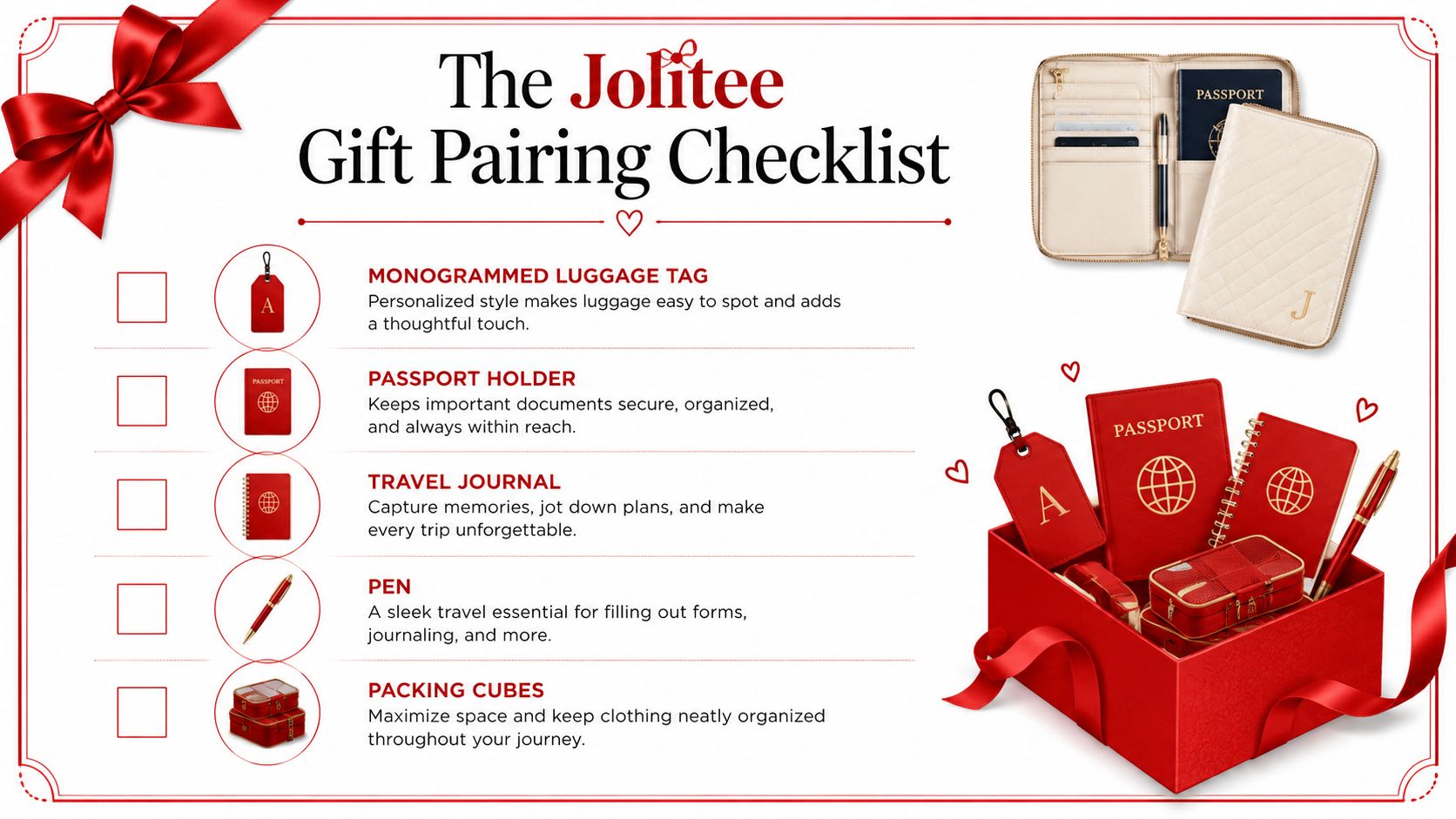
Start with a passport holder, then add a monogrammed luggage tag, a slim leather pen, and a packing checklist notepad. Tuck a printed itinerary card into the front pocket so the recipient opens the gift to a trip that already feels real.
Pair the gift with the occasion
For a bridal shower welcome bag, choose a refined organizer with a luggage tag and a small travel journal. For a corporate travel milestone, pair a sleek case with a pen and a notepad. For a retirement send-off, choose a richer color and add a handwritten note naming the first destination.
Blush, sage, and cognac work across different personal styles. A playful bottle bag from Jolitee's wine gift bag collection can also turn the presentation into part of the celebration, especially when the traveler is receiving the organizer at a dinner party or going-away gathering. For a more polished table-side gift, browse the hemstitch cocktail napkins and build a small host-worthy travel-and-entertaining pairing.
Care that lets the keepsake age well
Condition leather every six months, spot-clean canvas linings, and store the organizer flat with a tissue insert to help it hold its shape. Keep the case dry before closing it, and avoid overfilling compartments that were designed for quick access.
Embossing should look lived in, not precious. With every departure, the case gathers the marks of movement and becomes more connected to the person carrying it. That's what makes a practical gift memorable: it doesn't sit untouched on a shelf. It joins the journey.
Jolitee offers polished passport holders alongside giftable travel accessories, wine gift bags, and entertaining pieces that make a departure feel special. Visit Jolitee to browse a travel-ready gift or create a thoughtful pairing for the traveler, host, or friend on your list.